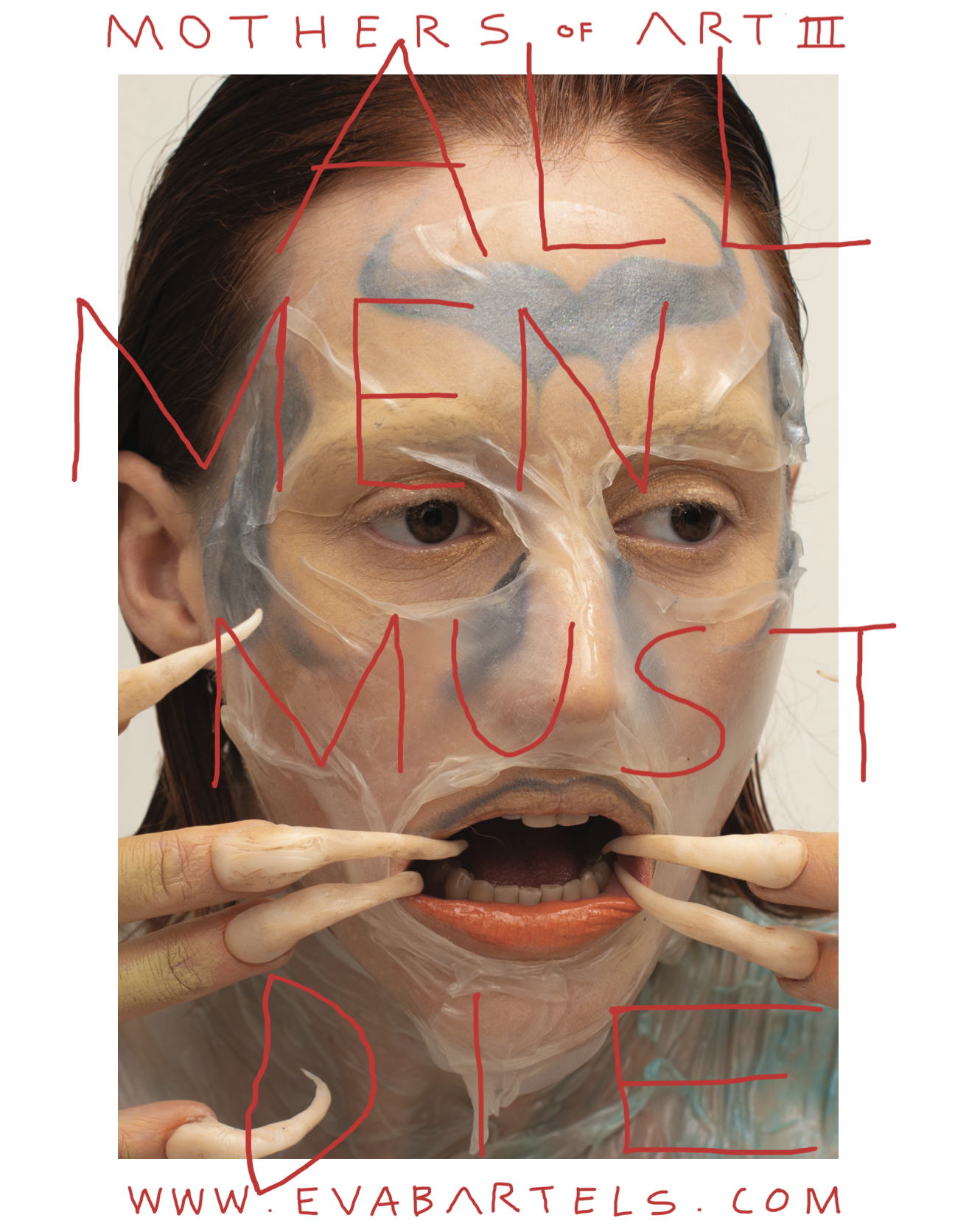
“All Men Must Die: Eva Bartels Turns SCUM into Urgent call to overthrow the abusive system.”
Seen on 21 April 2023, Studio Bartels, Amsterdam
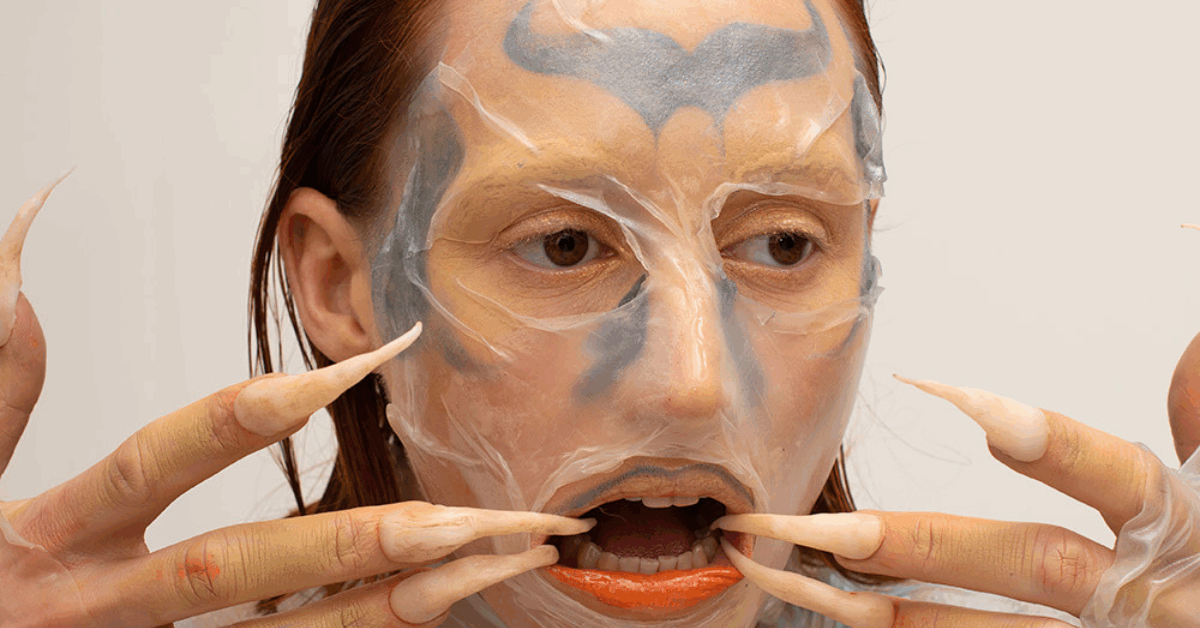
The American feminist activist Valerie Solanas, notorious for her attempted murder of Andy Warhol in 1968, imagines a society without men in her manifesto SCUM (Society for Cutting Up Men). In All Men Must Die, theatre-maker Eva Bartels invites the audience to read the manifesto as a science-fiction narrative and to step into Solanas’s world.
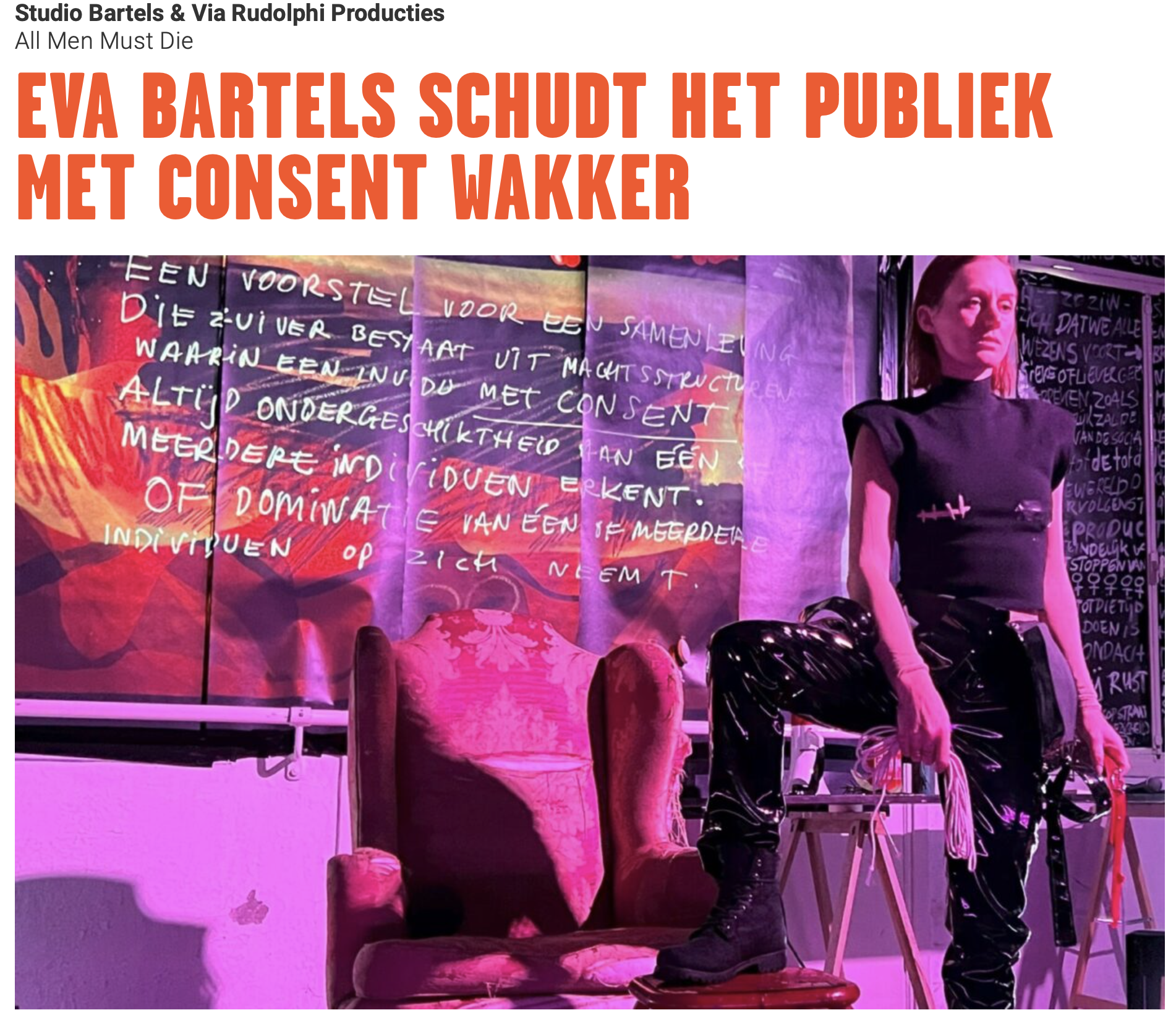
Handwritten excerpts from the manifesto are displayed on the walls, doors, and windows: “men are a walking abortion,” “he is a biological accident,” “our only task is to destroy the male sex and overthrow the financial system.” The destruction of “the man,” with all his privileges and authority rooted in biological characteristics, would signify the end of the patriarchal and capitalist system under which women suffer.
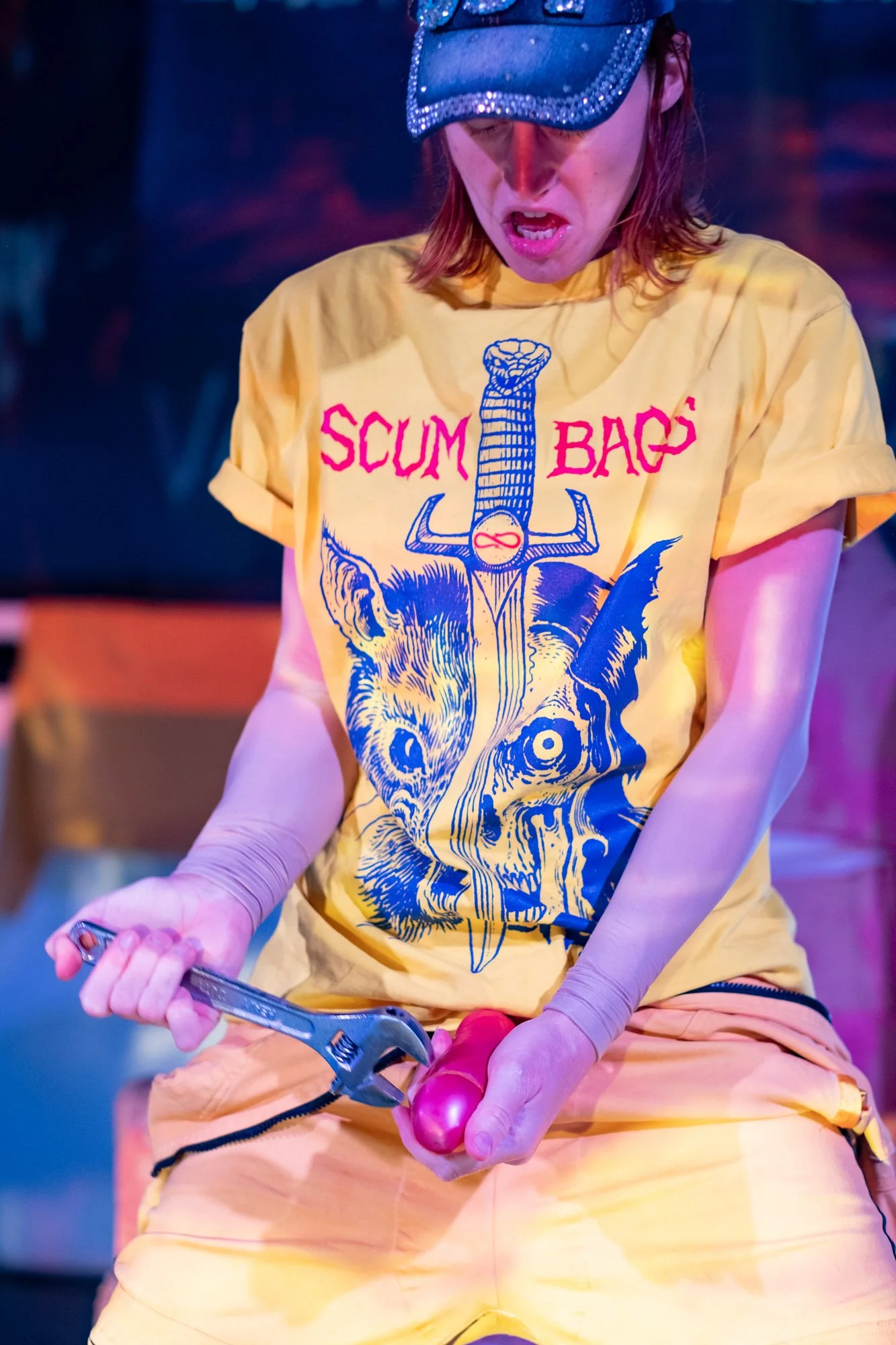
To the song I’m Too Sexy by Right Said Fred, the personification of toxic big-dick energy struts into the space. It is a convincing parody of “the man”: slouched, loud-mouthed, wearing a cap emblazoned with the word boy and carrying a toolbox that rattles obnoxiously loudly. From the perspectives of Bartels, Solanas, and other characters, the performance questions how we might shape a society in which power and oppression are not the starting point. Because the end of men will not mean the end of the system. Is a focus on consent the answer? Or does that once again place responsibility on the (heterosexual) woman?
In texts co-written with Han van Wieringen, Bartels shows how structural violence against women is bound up with power and can be found in every corner of our society. She is critical of the individual privileges of white women in Western society, while also exposing an institutional problem by referencing examples ranging from children’s books “in which the woman exists only to be rescued,” to the MeToo movement that has pushed sexual misconduct into the spotlight, to political leaders who continually violate people’s rights and openly advocate dominance over others. “Matthijs, Ali, John, Adolf, Thierry,” Bartels calls out to the audience. “When I receive compliments now, it feels as though something is being taken away from me.” The result is a society of hypervigilance and victim-blaming.
Between the chapters of the performance, the audience is given a trigger warning. In this way, spectators are informed about what they are about to see or hear, and their consent to witness it is explicitly requested. This is the moment to walk out or to remain seated. Bartels makes tangible what it truly means to give consent, rather than allowing theatrical conventions to strip the audience of agency over what they experience.
Bartels not only demonstrates the continued relevance of Solanas’s work in our contemporary society, but also holds up a mirror to the audience, challenging us to consider how we ourselves are part of this system. Through Solanas’s work, Bartels initiates a conversation—sometimes quite literally, by directly addressing the audience—about an immense structural problem. It is a clear call to action to interrogate our own contribution to a problematic system. In a system under which everyone suffers, the issue cannot be “the acquisition of equal rights,” but the overthrow of the entire system. A performance that jolts you awake—with consent.
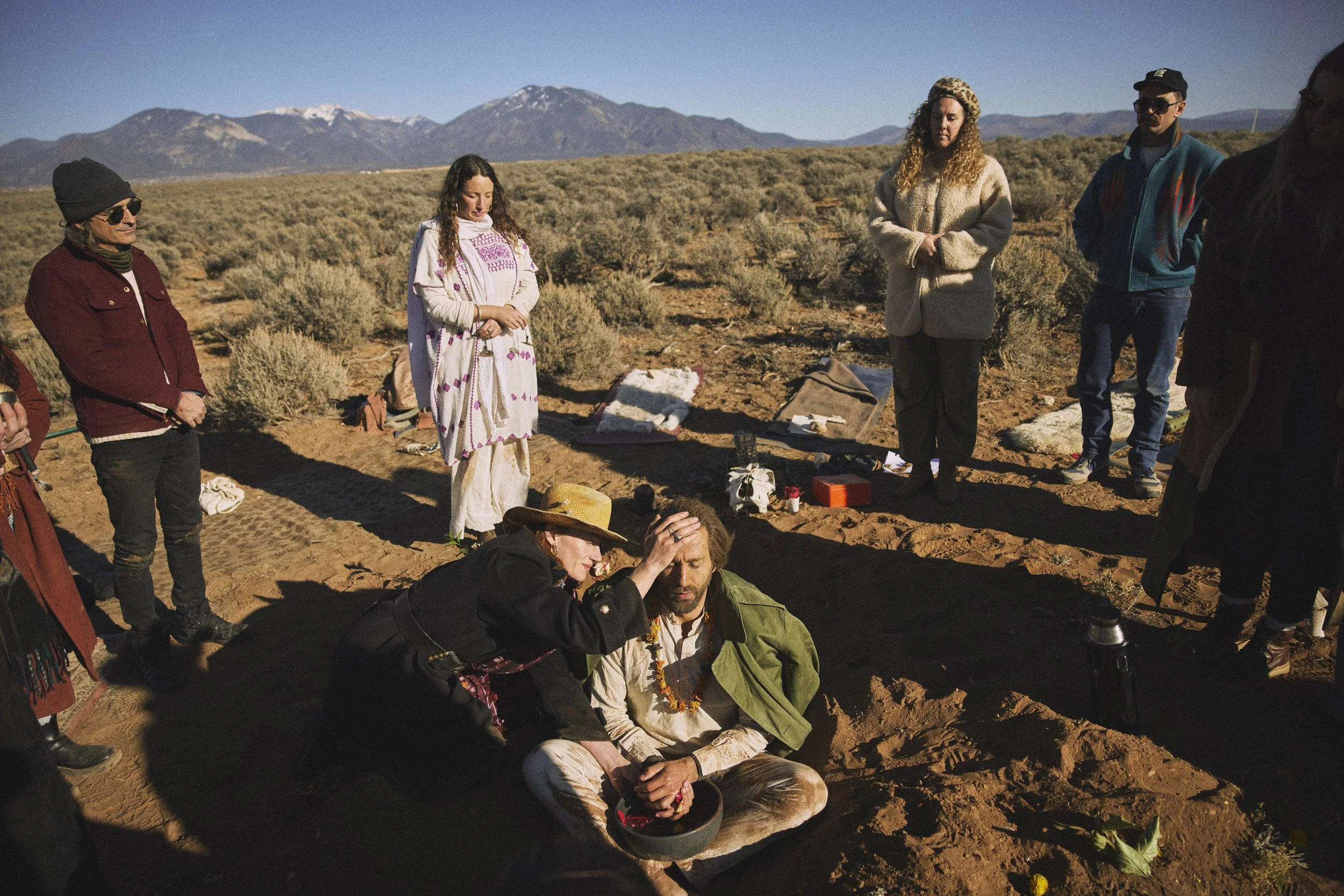
Photo: Max Melvill
Text Emilie van Heydoorn
25 april 2023